Gain, without pain? Lower-impact workouts are having a moment
– Roberta Burkhart, Pittsburgh Post-Gazette, 9/20/2026
"For years, the fitness world has seemed to operate on a simple premise: No pain, no gain.
If you aren’t sweating, straining and pushing yourself to the limit, you aren’t really exercising. Gentler approaches, however, are having a moment.
Chair yoga, tai chi walking and other low-impact workouts are increasingly turning up in social media feeds and fitness programs, promising movement without the intimidation — or physical demands — of pumping iron or a full-tilt aerobic class.
For people who are older, recovering from an injury, dealing with chronic pain or simply trying to get off the couch after years of inactivity, that accessibility can be a feature, not a bug.
But fitness experts say there is an important distinction between “gentle” and “easy.”
“The best exercise program isn't necessarily the hardest one. It's the one that's safe. It's one that's appropriate for the individual. It's the one that you can actually do, and that you will continue to do,” said Brian Oddi, an assistant professor at PennWest University’s exercise and sports science department.
That may help explain the appeal of gentle fitness. For someone who has been sedentary, for whatever reason, the prospect of a 60-minute boot camp or strenuous weightlifting session can be enough to keep them from starting at all.
“For a lot of people, just getting started is the biggest barrier sometimes,” said Lauren Maher, a psychotherapist and yoga teacher who created “The Chair Yoga Deck,” a card deck designed to guide users through chair-based yoga poses. Released in late August, the easily portable deck aims to make that initial step simple.
Easy going
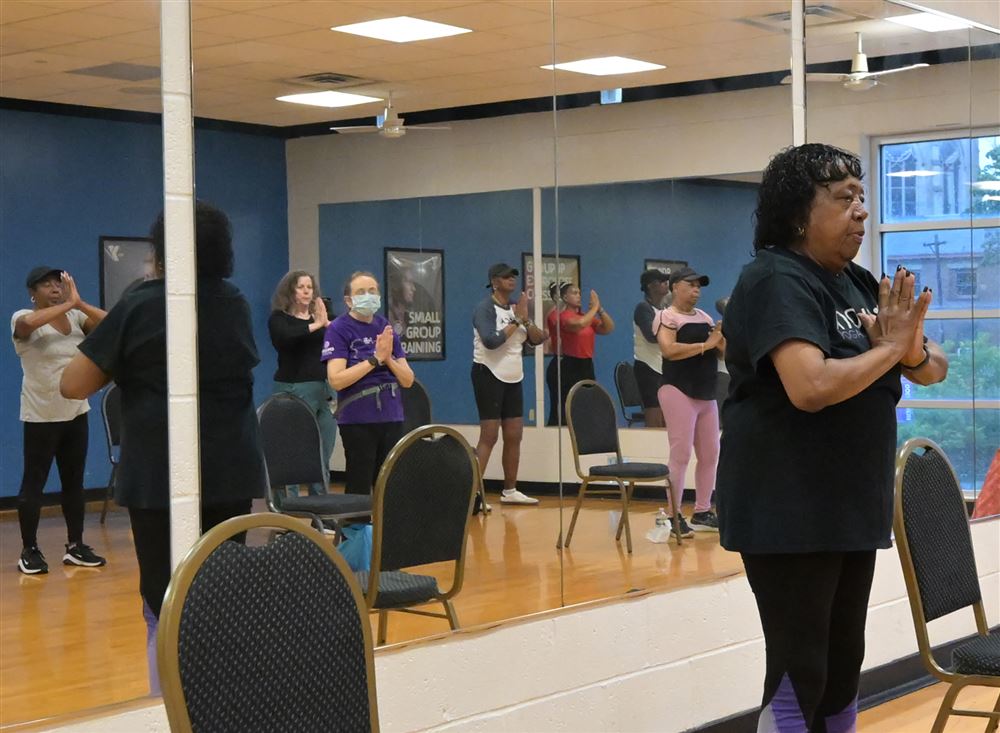
At the Homewood-Brushton YMCA, participants at a recent chair yoga session shared varied reasons for sitting down for a class.
Carlo Taylor of Penn Hills said she loves the class simply to keep her moving after her regular “floor” yoga class. The stress-busting aspect of yoga is important to her too.
Dottie Debow, 81 of Homewood said she uses chair yoga in addition to other gentle exercises, like walking, to keep her limber and feeling good.
Despite the name of the class — and yoga classes of various levels are taught across Pittsburgh-area YMCAs — participants didn’t stay seated for long. While the chair was helpful for some stretching moves, class members often stood beside theirs for other moves, using it as a reference point, a stability anchor and a base for sitting-then-standing moves.
Before she started doing chair yoga at the Y, Frances Maben, of Penn Hills, said she had “problems with aches and pains.” She especially appreciates both the stretching and sit-to-stand workouts that are core to the chair yoga program.
She likes to incorporate some of the moves she’s learned into her morning wakeup routine, before she even gets out of bed.
Maher’s yoga deck could work the same way: Pulling out two or three cards doing the exercises for a few minutes can help people take a manageable “bite” out of their daily exercise quota, Maher said.
“I love the idea of snacks: exercise snacks, mindfulness snacks, little relaxation breaks,” she said. “I think people shouldn't feel like they have to go take a 90-minute class somewhere to start.”
Gentle, with provisions
Christopher Sciamanna, a Penn State professor of medicine and public health sciences, does caution against assuming that an exercise program is effective simply because it is accessible.
At its most basic level, he said, exercise works by training the body for something it will need to do.
“I would say if you had to break it all the way down to its bare minimum, it's that you are training something that you one day need to use,” Sciamanna said. “So the question is, ‘What do I want to do tomorrow?’”
That means exercise generally needs to challenge the body enough to create an adaptation.
Sciamanna is particularly skeptical of chair-based exercise that never requires a person to get out of the chair. Sitting can allow someone to work on mobility and some muscular control, he said, but it may not provide enough of a challenge for balance and strength.
People naturally tend to choose the easiest option, he said, which means an exercise program needs to increase the challenge without making people feel overwhelmed.
“It's actually called the principle of least effort. People will always find the least effortful way to do something or to not do it at all.”
Tai chi may be an exception to the “too gentle” concern, Sciamanna said.
Although the movements are slow, they can challenge the body's ability to sense and control its position.
Oddi agreed that tai chi can be particularly valuable, especially as people age — when they can lose balance, mobility, flexibility and functional strength, all factors that can affect independence and increase the risk of falls.
“Tai chi, specifically, is one of the strongest evidence-based forms of gentle movement,” Oddi said.
Research has documented benefits including improved balance and coordination, lower-body strength and mobility, flexibility, blood pressure, sleep and stress, he said.
For those reasons, Oddi sees gentle exercise as potentially useful for a wide range of people, including those who have arthritis, chronic pain and some neurological conditions, are recovering from injuries or are sedentary.
“Movement in itself is medicine. And like any medicine, it's the right dose depending on the individual,” Oddi said.
The challenge for consumers is determining what that “dose” should be.
A person who is starting from a sedentary lifestyle may see substantial benefits from a gentle program that gets them moving. Someone who is already fit may need considerably more intensity to continue making gains.
Agnes Curry, 85, of Point Breeze North, said chair yoga at the Y has aided her recovery from a hip replacement. “This is really concentrated on each muscle, and it makes you mindful of your body parts,” she said.
A friend joked that, at her age, she’s now in the “overtime” period. “And [overtime] is when you really have to fight,” Curry said, adding that she makes an effort to avoid sitting too much and keeps her body moving as much as possible.
How to choose
Oddi recommends looking for exercise programs backed by credible, peer-reviewed evidence rather than relying on testimonials or social media claims.
Maher also cautions against the old “no pain, no gain” mentality. Exercise should not hurt, she said, and anyone with a medical concern or recovering from surgery should check with a doctor before beginning.
“If you find you're straining in any posture, then we want to back off,” she said.
Ultimately, the best gentle workout may be the one that gets someone moving consistently — and then keeps asking a little more of them over time.
Sciamanna's advice is to make progress in a way that’s trackable. A person who walks, for example, can note their pace and gradually work toward walking faster rather than simply walking farther and farther.
“Unless you make progress visible, your human nature will be to go slower and slower,” he said.
Maher sees the value of gentle fitness somewhat differently. For her, the goal isn't to replace more vigorous exercise but to give people another way into movement — one that feels manageable rather than intimidating.
“Yoga is for everyone,” she said. “It's for every kind of body type. It's for all ages. There is always a way in, and there's always a way to adapt postures.”
Gentle, she said, doesn't have to mean effortless."